Saturday, July 20, 2013

#41 The First Living Cell

Let’s take a couple of minutes to think about the origin of life in the very, very first living cell. Many people think about the beginning of life as something that just happened easily and naturally. One small, tiny, simple cell just spontaneously and accidentally happened. A bunch of chemicals in some goo formed into a blob. No big deal.

If you think that first living cell was just a blob of goo, then it doesn’t seem like much of a stretch from pond scum or murky soup of chemicals to a little tiny cell. Some bolt of lightning or other source of energy zapped the chemicals and voila, suddenly life started.

Believers in Evolution do not (and cannot) begin to apply their theory until after life exists and has started reproducing. Mutation and Natural Selection, the processes of Evolution, cannot operate until there is already life reproducing itself. The Theory of Evolution does not explain where everything before life came from or how life itself got started. (It’s obviously therefore, a sort of religion requiring faith.)

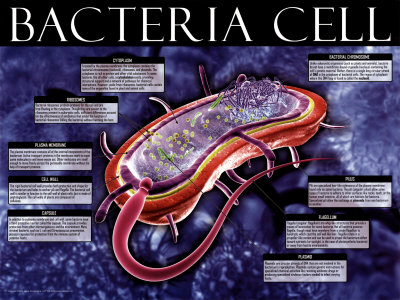
But for right now, let’s think about that first living cell a little more deeply given what we now know about living cells. What are some of the qualities that first living cell had to have in order for life to exist in it? We now know from Biology there are certain basic requirements for life to exist and the whole process is extremely complicated. [1]
Click for enlargement
Suppose you laid all the individual parts for an automobile out on your driveway, can you now imagine any possible scenario that could take place in the next billion, billion years where those parts get organized by some natural (i.e. no intelligence added) process into a fully functioning car that you could someday drive away? There could be lightning bolts, hurricanes, floods, windstorms, asteroids, whatever, but nothing is going to assemble anything.

With all the microscopic research done in cell biology, we now know that even a single tiny little cell is like a busy little city.[2] It’s much more complicated than an automobile. Even if you had all the chemicals necessary for life in one place like a swamp or deep ocean setting, getting it organized into some form of first living cell is on the order of complexity of simultaneously assembling all the different cars in America.

Here is a short list of some of the attributes that would have been necessary for the first living cell. There are others that you can find in the research if you want to go into more depth. I’ll expand on some of these later on after the list.

1. Reproduction and Inheritance.[3] The first living cell had to be able to reproduce a second living cell or there would never have been any more life. It also had to pass on its genetic characteristics by some mechanism such as DNA.

2. Cell Membrane.[4] There had to be a wall around the contents of the cell to hold in the material. Otherwise, it would drift away or be destroyed by other chemical processes. The Cell Membrane also has to be permeable to let chemicals go in and out. It must also be able to grow in size.

3. Digestion for Energy.[5] Life requires a process to get energy. There had to be a system for breaking down chemicals and converting it to get energy out of them.

4. Protein Production.[6] There had to be a system for making proteins and enzymes or it could never reproduce itself. There are 20 basic amino acids that are necessary for all the known life forms.

5. Repair capability.[7] All DNA and RNA molecules are subject to harmful mutations and damage from other chemicals. There had to be a process of repairing them when they are multiplied.

6. Elimination of Waste.[8] There would need to be a process for getting rid of used up chemicals.

7. Respiration.[9] Most life forms take in oxygen in some way. Scientists are still debating if the first living cell would have required a process of taking in oxygen.

So here is a pretty amazing list of abilities required for life. I might also have included growth as a property and another property might be sensing and responding to the environment.[10]

To go from a goo of chemicals to a fully functioning living cell that meets the above requirements without any intelligence applied seems a lot less likely than assembling an automobile. You might be able to imagine how one or two of the above processes or systems could have happened, but all of them is not reasonable or logical.

Let me quickly mention a couple of famous headlines about scientists creating life in the laboratory. First is the Miller–Urey experiment in 1953 [11]. They put the hypothesized original chemicals in a test tube and hit it with a bolt of electricity. The result was the formation of some amino acids (less than 10), the so called building blocks of life. Even though this experiment is still found in a lot of science textbooks, it has been fully discredited because the early earth’s atmosphere was not like they hypothesized.[12] And even if they got some amino acids, it takes 20 to build a protein. That’s like getting only some of the simplest car parts on your driveway, it’s not a functioning car.

Second, on May 20, 2010, Craig Venter, a pioneer in human genome research was able to synthesize a living bacteria.[13] It was hailed as “creating life”. What they did was figure out the DNA of an already living cell. They were able to synthesize a genome of over a million DNA base pairs sequence using very complicated processes and millions of dollars. One part of the process required yeast to help copy the DNA because a machine cannot do it. At one point there was a mistake of a single base pair missing and it wouldn’t work. It took them 3 months to find the error and then make the copy correctly. They then inserted this DNA back into an already living cell with its DNA removed. If you call that “creating life”, you have to ignore the fact that all they really did was COPY the DNA of “life” that already existed. Even then they had to put the DNA they copied back into a previously living cell for it to function. The cell of cytoplasm where they put the DNA already had a cell membrane and the systems required for cellular tasks like carrying sugars, copying DNA, removing wastes, converting energy, regulating production speeds, communicating with the environment, and so on.[14] This is an amazing accomplishment to be sure and I don’t want to minimize it, but look at all the intelligence that has gone into it. It has taken some really, really smart people 15 years to get this far and they’ve hardly started. So how much intelligence will it take before they can “create life”, if ever. Will they still try to claim life happened accidentally with no intelligence behind it. That would be laughable.

Okay, back to the list and Requirement Number 1, Reproduction. Think back to Biology class in school where you learned about mitosis and cell division. The first living cell had to be able to do that all by itself the very first try. Otherwise there would be no second living cell. We know that all reproducing cells contain DNA, a very complicated molecule.[15] It is the mechanism that inherits the characteristics of the cell to the next generation. The simplest life forms must have a DNA molecule of thousands of base pairs.[16] It would have to somehow decide to split in half and make an exact perfect copy of itself. Then the two strands would have to separate into two different areas of the cell and the cell membrane would surround each one and split into two new cells.
Click for enlargement
Evolutionists have to believe that the DNA pre-exited the first living cell. It could not logically have formed accidentally at the same time as the cell membrane formed or after the cell already existed. However, DNA is too complicated to last outside a cell. This idea has basically been deemed unlikely because DNA cannot exist for long without protection from harmful mutations and serious breakdown from contact with oxygen and other chemicals and ultraviolet light.

Number 2, Cell Membrane. There has to be a cell membrane to surround the cell, otherwise you don’t have a cell. But a cell membrane is an extraordinary boundary. If you have ever seen an animation of what’s happening all the time with the membrane that surrounds a living cell, you will be amazed.[17] You probably did science experiments in school with osmosis. Well, osmosis is going on all the time with nutrients, water, oxygen and other chemicals passing in and out of the cell through the membrane. Just where did the membrane around the first living cell come from? Could something like that have been floating around in the soup too at the same time as all the perfect chemicals and scoop them up and then close the whole thing like a fishnet?

I think this is getting too long. But as you can see, each well established attribute of a living cell that is listed above would require more intelligence than we currently have in the world of science.

There must be God.
------------------------------------------------

[1 ] Why the Miller–Urey Research Argues Against Abiogenesis, by Jerry Bergman, August 1, 2004, Institute for Creation Research, http://www.answersingenesis.org/tj/v18/i2/abiogenesis.asp
“The eukaryote protozoa, believed in Darwin’s day to be as simple as a bowl of gelatin, are actually enormously complex. A living eukaryotic cell contains many hundreds of thousands of different complex parts, including various motor proteins. These parts must be assembled correctly to produce a living cell, the most complex ‘machine’ in the universe—far more complex than a Cray supercomputer.”

[2] An Analogy for the Genome. http://richardhartersworld.com/cri/2002/analogy.html. "Imagine a small walled town. Within it there is a diversified population of people performing different tasks. There is a butcher and a baker and an undertaker, guards at the gate and a refuse collector. The people in the town are good at their tasks but they are quite stupid so anything novel is a real problem for them. Fortunately there is a library in the town, a library which contains instructions for dealing with unusual situations."

[3] ] How Evolution Works, Marshall Brain http://science.howstuffworks.com/life/evolution/evolution11.htm

[4] How Evolution Works, Marshall Brain http://science.howstuffworks.com/life/evolution/evolution11.htm

[5] ] How Evolution Works, Marshall Brain http://science.howstuffworks.com/life/evolution/evolution11.htm

[6] ] How Evolution Works, Marshall Brain http://science.howstuffworks.com/life/evolution/evolution11.htm

[7] Wikipedia. http://en.wikipedia.org/wiki/DNA_repair “DNA repair is a collection of processes by which a cell identifies and corrects damage to the DNA molecules that encode its genome.”

[8] Properties of Life: Homeostasis, http://plantphys.info/organismal/lechtml/biology.shtml

[9] The Respiration Process: “one of 7 characteristics of all living organisms.” http://www.biotopics.co.uk/humans/respro.html

[10] Wikibooks: Structural Biochemistry/Properties of Living Organisms http://en.wikibooks.org/wiki/Structural_Biochemistry/Properties_of_Living_Organisms

[11] Duke University, Miller/Urey Experiment http://www.chem.duke.edu/~jds/cruise_chem/Exobiology/miller.html

[12] Why the Miller–Urey Research Argues Against Abiogenesis, by Jerry Bergman, August 1, 2004, Institute for Creation Research, http://www.answersingenesis.org/tj/v18/i2/abiogenesis.asp

[13] Scientific American, May, 2010, Man-Made Genetic Instructions Yield Living Cells for the First Time, http://www.scientificamerican.com/article.cfm?id=synthetic-genome-cell

[14] Have Scientists Created a Living Cell?, Brian Thomas, Institute for Creation Research, http://www.icr.org/article/5485/

[15] Complicated Cells Leave No Room for Evolution, Brian Thomas, http://www.icr.org/article/5353/

[16] The Smallest Genome: What's the Minimum DNA Amount for Life?. http://news.softpedia.com/news/The-Smallest-Genome-What-039-s-The-Minimum-DNA-Amount-for-Life-73763.shtml. “Nanoarchaeum possesses the smallest genome in the world: just 490,885 pairs of nucleotid bases.”

[17] www.YouTube.com. Search for “animation of cell membrane”. Suggested examples: http://www.youtube.com/watch?v=1Z9pqST72is. This animation shows the working of DNA, RNA, proteins, and ribosomes. http://www.youtube.com/watch?v=gdBJt6sdDfI

Wednesday, June 26, 2013

#40 - Chirality: Chemical Handedness

Here’s a great proof for God from Chemistry that I recently learned about.

“When two molecules appear identical and their structures differ only by being mirror images of each other, those molecules are said to have chirality. Your left and right hands illustrate chirality. Your hands may appear to be identical, but in reality, they are only mirror images of each other, hence the term handedness.” [1]

You probably know that DNA is made up of four simple nucleotides and that DNA is in the shape of a spiral staircase. Well, actually, getting even more specific, DNA is always in the shape of a right-handed spiral staircase.


When amino acids are formed in the laboratory, they can result either way, “left-handed” or “right-handed” in a 50% to 50% ratio.

“In our body, every single amino acid of every protein is found with the same left-handed chirality. ... It is a universally accepted fact of chemistry that chirality cannot be created in chemical molecules by a random process. When a random chemical reaction is used to prepare molecules having chirality, there is an equal opportunity to prepare the left-handed isomer as well as the right-handed isomer. It is a scientifically verifiable fact that a random chance process, which forms a chiral product, can only be a 50/50 mixture of the two optical isomers. There are no exceptions.” [2]

“The DNA molecule is made up of billions of complicated chemical molecules called nucleotides, and these nucleotide molecules exist as the “R” or right-handed optical isomer. The “L” isomer of nucleotides can be prepared in the lab, but they do not exist in natural DNA. There is no way that a random chance process could have formed these proteins and DNA with their unique chirality.” [3]

“How can a random chance natural process create proteins with thousands of “L” molecules, and then also create DNA with billions of “R” molecules?” [4] A random process always results in a 50-50 mix.

To make a strand of DNA step by step as evolutionists claim and still make the correct spiral, all the steps in the strand must bend the same way, i.e. right. In another post I talked about how human DNA has over 3 billion “steps on the ladder” or characters in the chain. All those characters have to be in the correct order or you don’t get a human being.

Chirality adds an even more impossible level of difficulty for DNA to have formed by accidental mutation as the evolutionist faith believes. In building up the DNA staircase step by step, every step that is added must turn out to be ones that bend to the right. If you were going to build a spiral staircase with your eyes closed and you start out with an equal number of left and right handed steps, you could never build the spiral randomly. Impossible.

Here is one very famous case of chirality in life. Do you remember the drug Thalidomide. It ”is a sedative drug that was prescribed to pregnant women, from 1957 into the early 60's. It was present in at least 46 countries under different brand names. ‘When taken during the first trimester of pregnancy, Thalidomide prevented the proper growth of the fetus, resulting in horrific birth defects in thousands of children around the world’. Why? The Thalidomide molecule is chiral. There are left and right-handed Thalidomides, just as there are left and right hands. The drug that was marketed was a 50/50 mixture. One of the molecules, say the left one, was a sedative, whereas the right one was found later to cause fetal abnormalities. ‘The tragedy is claimed to have been entirely avoidable had the physiological properties of the individual thalidomide [molecules] been tested prior to commercialization." [5]

Another example is the artificial sweetener, Aspartame, which is more than a hundred times sweeter than sucrose. However, the mirror image molecule is bitter.

Not only is all DNA right-handed, but proteins are all left-handed. There are 20 different amino acids needed in your body to sustain your life. They are the building blocks for an estimated 2 million proteins in your body. Your DNA acts like the “designer” for the proteins. It links molecules together along its length by a type of hand-clasping or matching. This is why when the proteins are formed, they are all left-handed when they separate to go about their important functions in the body.

In 1953, Stanley Miller and Harold Urey did an experiment with a mixture of methane, ammonia, hydrogen, and water vapor by passing it through an electric discharge. A few amino acids resulted and the newspaper headline was “Life in a Test-tube.” Don’t be fooled. Sure amino acids make up proteins and proteins are important for life, but a few amino acids are not life any more than a few auto parts laid out on your driveway make a car, especially if the parts are all left-handed. By the way, it turns out their experiment was discredited anyway because their mixture of ingredients is no longer believed to be the original formula for the primitive atmosphere of the earth. [6]

Your body is a walking miracle every instant in time. The chirality of all the amino acids and nucleotides proves it.

There must be God.

---------------------------------------------------------

[1] Evolution Hopes You Don’t Know Chemistry: The Problem With Chirality. Charles McCombs, PhD Organic Chemistry. Page ii, paragraph 2. http://www.icr.org/i/pdf/imp/imp-371.pdf

[2] Evolution Hopes You Don’t Know Chemistry: The Problem With Chirality. Charles McCombs, PhD Organic Chemistry. Page ii, paragraph 3. http://www.icr.org/i/pdf/imp/imp-371.pdf

[3] Evolution Hopes You Don’t Know Chemistry: The Problem With Chirality. Charles McCombs, PhD Organic Chemistry. Page iii, paragraph 1. http://www.icr.org/i/pdf/imp/imp-371.pdf

[4] Evolution Hopes You Don’t Know Chemistry: The Problem With Chirality. Charles McCombs, PhD Organic Chemistry. Page iii, paragraph 2. http://www.icr.org/i/pdf/imp/imp-371.pdf

[5] http://chirality.ouvaton.org/homepage.htm

[6] Icons of Evolution, Science of Myth? Why much of what we teach about evolution is wrong, Chapter 2, Jonathan Wells. Regnery Press, Washington, DC, 2000

Wednesday, June 19, 2013

#39 Trees

I’m going to assume that almost every person loves trees. They are everywhere around us with about 100,000 different species, but we often take them for granted.


Without trees we wouldn’t exist. They take the carbon dioxide that we exhale out of the air and return to us oxygen that we need for survival. What a phenomenal coincidence if you don’t recognize a master designer. The whole amazingly complicated and delicately balanced ecosystem exists to perfectly support our existence.

Trees have a vascular system that passes water and nutrients throughout all the cells in the tree, somewhat similar to our own circulatory system of blood.


Trees produce for us an amazing variety of fruits that we love. They are almost all tasty in our mouths and at the same time very healthy for our bodies. Yet, there is a tremendous variety: apples, oranges, citrus, peaches, pears, cherries, coconuts, and so many others.

Trees produce in great abundance, far more than is needed for their survival…almost like they do it for us. Trees are the great “givers” in nature. I will always remember this big old cherry tree that my aunt and uncle had in their backyard. That thing produced so many cherries that they could never give enough away to the whole neighborhood. As hard as they tried, the ground would always be covered with a layer of rotting cherries.


Forests of trees support the life and existence of many other plants as well as myriads of insects and animals.

Trees give us shade from the hot sun and they shelter us from the rain like a big protective friend.

Trees give us their wood for building our houses and thousands of other creations. For thousands of years we burned the wood of trees to keep warm and to cook meals.


Many a romantic moment has happened in front of a burning fire. One of the greatest joys of going camping is sitting around the fire in the evening.

Trees give us paper. The vast majority of human knowledge that was ever shared in history was made possible by paper from trees.

Trees directly or indirectly provide jobs for a large segment of the population.

Another incredible aspect of trees is that they start from a small seed. A seed is truly a miracle in itself, containing nourishment to begin its life and all the DNA information needed to build the tree for its whole lifetime. The first thing to emerge from the seed is the "taproot" which goes straight down into the ground.

Some of the largest seeds come from trees, but the largest tree, Sequoiadendron giganteum, produces one of the smallest tree seeds. (see picture)

Ancient trees that are now under the earth have turned to coal which has also been another huge contributor to human development; heating buildings, driving steam engines for manufacturing and locomotives to move people and business; and making steam power to generate the majority of electricity in the world.

Every little boy who ever walked in the woods has picked up a stick and done wondrous things with it.
Trees can touch the sky like the Redwood in California named Hyperion that is 379.5 feet high. 

Trees remind us of the past like the Great Basin bristlecone pine called Methuselah (above). It has been dated by drilling a core sample and counting the annual rings at 4,844 years old in 2012. 

The largest living thing on earth is the Sequoia named General Sherman (below) at 52,508 cu ft. 


Trees can also be miniaturized like the Japanese Bonzai to display elegant beauty.


I'm really moved by the awesomeness of the Kapok tree.

Every autumn I try to make a trip to upstate New York when the leaves are changing color. It is spectacular and I never get tired of it. The trees do it for us every year like a living painting.

Trees are not an accident or some plant that happened to have the best materialistic, heartless survival abilities. Trees were designed with us in mind and are a precious life-giving gift to us from someone who loved us before we were born.

We could not exist without them.

There must be God.

Tuesday, June 18, 2013

#38 Practice Makes Perfect

From the time that we were little children, we have heard the axiom that “Practice makes perfect.”

We all know the meaning of it, namely that just about anything in life that is worth doing or learning takes practice. You don’t get it right the first time. From potty training, to learning to walk, to brushing your teeth, to kindergarten, to playing a sport, playing an instrument, getting a job, to cooking your dinner, to about everything else, it takes practice to get it right. 


Do you find anyone out there advocating “It takes an accident to make it perfect?” When you get right down to the bottom line, that’s what atheists believe. Life itself was an accident. For each higher level of species, there were more accidents (mutations). 

The Big Bang was an accident of some kind. The appearance of life from non-living chemicals was an accident. 

Most atheists will admit that random mutation cannot generate successful changes for producing evolution so they will add in “natural selection” as the cure all because it magically adds a “positive” directedness. But as I detailed in a previous Proof for God (#35), natural selection is never the source of new information. It only acts on what exists already which can be inherited. No new information comes from it.

If mutation does not work and natural selection does not work, then adding them together will not work. “Practice makes perfect” obviously means good practice, not bad practice. Bad practice added to bad practice makes a worse result.

You and I might be able to conceive of one or two accidents that happen to go “right” (i.e. toward the direction of evolution), but millions upon billions upon trillions of accidents that go right is NOT conceivable.

Michael Jordan made 49.69% of his shots in his career by practicing a lot, not by accident. 


The number one hitter of all time in baseball, Ty Cobb hit successfully 36.6% of the time in his career by practicing a lot, not by accident.

Nobody is any good at anything complicated by accident.

People who decide to be atheists have concluded that all the incredible complexity from the biochemical level up to the intergalactic level including all the flowers, fish, birds, and animals exist by accident followed by reproductive selectivity, followed by another accident, followed by more selectivity on and on to the millionth degree.

Huh!

I believe that atheists start out with a decision that there is no God and then proceed to conjure up a way that this observable world “might” have come about. Then they believe in that. They don’t start with the observable data known to science today and propose a theory. They start with the assumption that there is no God and a theory from 154 years ago. Conclusions and theories should come after analysis of data, not the other way around.

Many examples of people falsifying the data (on both sides) exist in the scientific fields. Also many advances in science have proven previous theories were false. But the “old truths” were slow to die because those who believed in them could not give them up. We have to be careful who we bow down to as our authorities. Darwin thought a cell was mostly an uncomplicated mass of protoplasm. That’s far, far distant from what biochemists know today since the electron microscope was invented.

Even Albert Einstein admitted he fudged the data when it led him to the conclusion that the universe was expanding. That would have meant the universe must have had a beginning at a certain point in time which would clearly imply a creator. Later when the research of others like Hubble also concluded the universe was expanding, Einstein admitted his falsification. [1] [2] He called it his “biggest blunder.”

Science is clearly closing in on atheists and making it harder and harder to sustain their beliefs.

Dr. Paul Zulehner, dean of Vienna University’s divinity school and one of the world’s most distinguished sociologists of religion, has said that atheists in Europe have become “an infinitesimally small group. There are not enough of them to be used for sociological research.” [3] Also, “John Updike’s observation, “Among the repulsions of atheism for me has been its drastic uninterestingness as an intellectual position,” appears to have become common currency throughout much of the West.” [4]

"And if you think it is challenging to be a Catholic parent, try being an Atheist parent! Some 70% of Americans raised to believe God does not exist end up being a member of a religion as an adult." [5] That is the worst retention rate of any "faith".

Real scientists go where the evidence leads. They don’t cling to unverifiable dogma. The truth about God and evolution will not be suppressed for much longer in science.

There must be a God.

----------------------------------------------------------
[1] http://www.space.com/9593-einstein-biggest-blunder-turns.html
"In 1917, Albert Einstein inserted a term called the cosmological constant into his theory of general relativity to force the equations to predict a stationary universe in keeping with physicists' thinking at the time. When it became clear that the universe wasn't actually static, but was expanding instead, Einstein abandoned the constant, calling it the '"biggest blunder" of his life."

[2] http://www.sciencedaily.com/releases/2007/11/071127142128.htm
Then, 12 years later, Edwin Hubble discovered that the universe is not static -- it is actually expanding. So Einstein scrapped his idea of a cosmological constant and dismissed it as his biggest blunder.

[3] Analysis: Atheism worldwide in decline. By UWE SIEMON-NETTO, UPI Religious Affairs Editor, Published: March. 1, 2005
http://www.upi.com/Business_News/Security-Industry/2005/03/01/Analysis-Atheism-worldwide-in-decline/UPI-20691109700930/

[4] Atheism worldwide in decline. By UWE SIEMON-NETTO, UPI Religious Affairs Editor, Published: March. 1, 2005
http://www.upi.com/Business_News/Security-Industry/2005/03/01/Analysis-Atheism-worldwide-in-decline/UPI-20691109700930/

[5] Center for Applied Research in the Apostolate (CARA). See chart of retention rates among all faiths at this website: http://nineteensixty-four.blogspot.com/2012/06/reverts-catholics-who-left-and-came.html

Saturday, June 8, 2013

#37 Information

“There is enough capacity in a single human cell to store the Encyclopedia Britannica, all 30 volumes of it, three or four times over.” [1] This is a quote from Richard Dawkins.

I don’t know about you but if I came across an encyclopedia that was three or four times the size of the Encyclopedia Britannica, you could never get me to believe that it came into existence without any intelligence behind it. But that’s what Richard Dawkins, famous atheist, believes and evangelizes, and probably also makes a lot of money espousing.


“To illustrate further, the amount of information that could be stored in a pinhead’s volume of DNA is staggering. It is the equivalent information content of a pile of paperback books 500 times as tall as the distance from the earth to the moon, each with a different but specific content.” [2]


Let me say that in a different way for you. The distance between the earth and the moon varies, but the average is 238,900 miles (384,400 km). Imagine a stack of paperback books, all different, that is 11,945,000 miles high. Now shrink down all that information until you can put it on a pinhead. That is the reality of the world around us. That’s how much information exists all around us in every square millimeter of the plants, animals, and people we see. Almost incomprehensible!


Atheists do not believe there was any superior intelligence behind all that information. It all comes from accidental mutations and natural selection (which I have already written about as processes that LOSE information). The more scientists discover about DNA and microbiology, the harder atheists have to work to keep believing in nothing as the source of life.

“…But in all the reading I’ve done in the life-sciences literature, I’ve never found a mutation that added information. …All point mutations that have been studied on the molecular level turn out to reduce the genetic information and not to increase it.” [3]

(NOTE: Let me say that in layman's terms. The very type of mutation that evolutionists depend on happening billions of times to produce all current life forms has NEVER EVER been observed even once in the history of science.)

Life cannot exist without order and information. Every living being starts out with a single cell which contains all the information needed to eventually build the complete organism. When scientists tried to determine the smallest amount of information necessary to still end up with a potentially living organism, they came up with 256 genes. But they profess this theoretical organism might not be able to survive on its own.

“More recently, Eugene Koonin and others tried to calculate the bare minimum requirement for a living cell, and came up with a result of 256 genes. But they were doubtful whether such a hypothetical bug could survive, because such an organism could barely repair DNA damage, could no longer fine-tune the ability of its remaining genes, would lack the ability to digest complex compounds, and would need a comprehensive supply of organic nutrients in its environment.” [4]

“Is it really credible that random processes could have constructed a reality, the smallest element of which – a functional protein or gene – is complex beyond our own creative capacities, a reality which is the antithesis of chance, which excels in every sense anything produced by the intelligence of man? Alongside the level of ingenuity and complexity exhibited by the molecular machinery of life, even our most advanced artifacts appear clumsy…” [5]


Encyclopedic amounts of information are required for the most basic form of life to exist. It could not be assembled step by step and then suddenly come to life. The information had to already be there at the beginning of life.

Imagine the most complex system you can think of, say a supercomputer, a skyscraper, a spaceship, whatever. The amount of information to build those systems is not enough to build the first living cell. Life is no accident.

There has to be God.
_________________________________________

[1] Famous atheist Richard Dawkins, The Blind Watchmaker, p. 115. (New York: W. W. Norton 1986)

[2] Jonathan Sarfati, Refuting Evolution. p. 121 (Green Forest, AR, Master Books, 1999). Original information from W. Gitt, “Dazzling Design in Miniature”, Creation Ex Nihilo, 20(1): 6, December 1997-February 1998.

[3] L. Spetner, Not by Chance (Brooklyn, NY: The Judaica Press, Inc.) p. 131-143.

[4] ] Jonathan Sarfati, Refuting Evolution. p. 123 (Green Forest, AR, Master Books, 1999). Original information from W. Wells, “Taking Life To Bits”, New Scientist, 155 (2095): 30-33, 1997.

[5] M. Denton, Evolution: A Theory in Crisis (Chevy Chase, MD: Adler and Adler Publishers, Inc. 1986), p. 328.

Tuesday, May 28, 2013

#36 The Zoo

When was the last time that you went to the Zoo? 

I don’t know about you, but I have always been fascinated at the zoo. The educational opportunities are endless and the exhibits are from all over the world, not just our country. It was always really special to go as a kid myself and then later to take my own kids when they were young. Now I’m looking forward to taking my grandchildren when they come along.

What kinds of animals do they put in a Zoo? Do you see dogs and cats, squirrels, robins and starlings, cows or horses there? No. They will always try to put animals there that you will never see in your neighborhood. They go for animals that are somehow amazing, especially for kids.

The largest Zoos in the world are Toronto Zoo and the Omaha Zoo, both with over 17,000 species of animals. Think about that. How long would it take you to study each unique one? Each has a totally different set of DNA and different physical characteristics, lifestyle, digestive system, reproductive systems, locomotion, on and on.

How many animals are there that you have never seen? How about fish or birds? Then there are plants and insects. I saw recently that there are 383 different species of hummingbirds alone.

Nobody knows how many species there are in the world. I searched around for estimates of how many species there are of all the kinds of living beings. Here is a link to a New York Times article that reports on an estimate of  8.7 million species.[1] But there are estimates as high as 100 million. Researchers are reporting over 15,000 new species discovered EVERY YEAR. Scientists have named and categorized ONLY 1.3 million so far.

If a zoo has 17,000 species, it only has 1.3% of the already named species, which is a small fraction of the estimated total number of species.
http://animals.about.com/od/zoologybasics/a/howmanyspecies.htm
There are 43,271 cataloged species of fungi of an estimated 660,000 to 5.1 million. There are approximately 6,500 species of millipedes. Mollusks, slugs, and snails make up an estimated 100,000 species. Starfish, sea urchins, and their relatives make up 6,500 species.

There are an estimated 5,000 species of mammals, 9,000 to 10,000 species of birds, 23,500 species of fish, 1 million to 30 million species of insects, 298,000 species of plants. The most amazing fact of all is that scientists really have no idea of how many species are yet to be discovered and estimates vary all over the place.

“We’ve only touched the surface of understanding animal life,” said entomologist Brian Fisher of the California Academy of Sciences. “We’ve discovered just 10 percent of all living things on this planet.” [2]

I personally guess he might be overestimating what we know.

I’ve collected a bunch of pictures below from websites of various zoos that show some strange and unusual creatures in their zoos. Look at these pictures and imagine that there are literally millions of other beings for each one of them. This is an extremely small sampling of amazing creatures.

If you want to be even more amazed, just go to Google Images and do a search for moths, butterflies, birds, snakes, dogs, cats, fish, or whatever else you can possibly think of. Then look over those images for a while. 

Evolutionists say they believe that every single one of these species exists totally and absolutely by accident, without any intelligence behind it. It was all godless mutations and survival of the fittest. They want me to believe that every color, shape, and ability came into existence because it was the result of millions of mutations and then natural selection choosing the character trait because it was the most "beneficial" for survival. To me that is so implausible as to be incomprehensible. I am flabbergasted that anyone could believe it.

I hope that they will go spend some time at the Zoo. In fact, let’s all go there.

There has to be God.
------------------------------------------------

[1] How Many Species? A Study Says 8.7 Million, but It’s Tricky. http://www.nytimes.com/2011/08/30/science/30species.html

[2] http://www.livescience.com/4593-greatest-mysteries-species-exist-earth.html

http://www.sfzoo.org/leafinsects
http://animal.discovery.com/tv-shows/other/videos/fooled-by-nature-star-nosed-mole.htm
http://www.torontozoo.com/ExploreTheZoo/AnimalDetails.asp?pg=640
http://www.philadelphiazoo.org/Animals/Birds/Other-Birds/Black-Capped-Lorikeet.aspx
http://www.sfzoo.org/pinktoetarantula
http://www.bronxzoo.com/animals-and-exhibits/animals/mammals/sifaka.aspx
http://www.sfzoo.org/aniseswallowtailcaterpillars
http://www.torontozoo.com/ExploreTheZoo/AnimalDetails.asp?pg=600
Grey-necked crowned crane
http://www.torontozoo.com/ExploreTheZoo/AnimalDetails.asp?pg=507  
MacLeay’s spectres
http://www.montereybayaquarium.org/animals/AnimalDetails.aspx?enc=n3f4wmcSJaMOCtHyd6DEPA==
http://www.torontozoo.com/ExploreTheZoo/AnimalDetails.asp?pg=473
Poison Dart Frog
http://www.torontozoo.com/ExploreTheZoo/AnimalDetails.asp?pg=813  
Longnose butterflyfish

http://www.omahazoo.com/exhibits/aquarium/
Bowmouth Guitarfish
http://www.amusingplanet.com/2012/12/meet-most-gorgeous-peacock-spider.html

Wednesday, May 22, 2013

#35 Natural Selection

The concept of “Natural Selection”, sometimes used synonymous with “Survival of the Fittest”, is often touted as the magic process that when added to mutation will result in advancing steps of higher and higher species and the success of evolution.[1] But I encourage you to read up on what Natural Selection is all about and see that it will NOT lead to evolution. Check out the examples that are given, and see for yourself what a fanciful argument this is for evolution of molecules to man. Actually you can't even start with molecules because Natural Selection ONLY works on a species once it can reproduce.

What they actually mean by "natural selection" is what we believers in God totally accept and we call it adaption to the environment. It’s a wonderful God-given quality in Nature that creatures have that allows them to better survive. But it is never a process that will give you a new species.

"Natural Selection" is also sometimes referred to as “Survival of the Fittest”. However, as a term used by scientists and evolutionists, it does not refer to what we normally think of as being “fit”, which means the healthiest, strongest, smartest, or fastest. For them it actually means the ones who were reproductively fittest and left the most descendants  To rephrase the term, we could say “Survival of the ones that survived”. Pretty unscientific huh?[2] Some of them even understand the problem with their logic, namely saying the same thing twice and calling it a proof. That’s tautology and not proof of anything. But then they go right on with the same type of assumptions anyway.

Most of us understand the concept of dog breeding or horse breeding where we selectively try to bring out certain characteristics like speed or size or something. It’s mating together certain males with certain females. This is all that Natural Selection claims it is doing EXCEPT it happens “out in the wild” without any interference from humans. Now who do you think can do a better job of purposeful breeding and selection, “the wilds of nature” or a human in a controlled environment of matching certain males and females? Need I remind you that humans have never been able to breed a new species with all their efforts (very intelligent, not mindless) over decades of trying.

Let’s walk through a simplified example and see if this process makes any sense as a mechanism for evolving any new species. Let’s assume there is a wild dog population where the dogs have genes for producing long-haired or short-haired descendants.  Assume also that one gene pair controls the length of hair. If a given dog has both types of genes (LH and SH for long hair and short hair), then it will have medium length hair.

What happens next, the environment changes and gets much colder over time. What supposedly happens? By Natural Selection the short haired dogs will die out faster, leaving more and more long haired dogs to reproduce. But looking at the genes, this process is not evolving toward a new or higher species. Actually the dog population is losing genetic diversity and DNA information, not gaining it.

So Natural Selection is not a process that will get you a new species at all because the species is LOSING genetic information. It's going backwards from the way evolution is supposed to go.

This is when evolutionist believers will fall back on mutation as the place where the new genetic information comes from. After there is mutation, then Natural Selection can work its magic. But we already saw in an earlier blog that mutation does not work. (See my blog on Mutation. [3])

So evolutionist believers count on two processes that demonstrably don’t work at all for producing evolution separately, but when combined somehow magically work. In mathematics, when two processes are combined, you multiply the odds of success of one process times the odds of success of the other. The odds will be even less likely when the two processes are combined. I remind you that 40 years of intentional and intelligent efforts to develop mutated fruit flies has never gotten anything but fruit flies. None of them that survived was better off (i.e. more “fit”) than the fruit flies they started with. Not even any improvements could be mutated into the fruit flies. But evolutionist believers will still insist that millions of extremely complicated species all happened accidentally. They don’t just believe in one very improbable accident, they believe in billions upon billions of progressive accidents one after another building up higher and higher levels of species. There are millions upon millions of species on earth (plants, animals, fish, insects, etc.), each functioning very successfully but with hundreds of very distinguishable characteristics.

Another problem at issue for Natural Selection producing evolution is “How do you get the starting point?” Natural Selection only works when there is already a living organism that can reproduce. Natural Selection cannot explain the first organism. Scientists now know that the simplest of all species capable of reproduction has at least 250,000 ordered genes. What explains ordered genes on that magnitude from an accidental process.

We creationists do believe in Natural Selection as it is OBSERVED in nature. God designed it and it testifies to God’s design skills. The truth about the process of Natural Selection is that it is a conservation mechanism that helps prevent species from going extinct by keeping harmful mutations from proliferating in a population. But as a proof for godless evolution, it fails miserably.

I invite you to Google “examples of Natural Selection”. All you get are examples of adaptations that creatures have made within a species, never one species evolving into another species. Molecules to man is an extraordinarily long path for evolution to try to walk.

The website for Discover.com has pages on the “10 Examples of Natural Selection” [4]. They offer different examples of peppered moths, colored snakes, chemical resistant insects, Galapagos Island finch’s beaks, male peacock tail feathers, a certain ability of warrior ants, deer mice changing color, etc., and even humans getting sickle cell anemia. All they talk about is changes WITHIN a species and still they name it evolution. Excuse me, that is NOT the definition of evolving. Just by waving the magic words, they claim this is the scientific proof that dirt became dinosaurs. Sorry, I can’t believe that, too preposterous.


I must conclude the evolutionists are not really looking at the evidence impartially, they have already decided the conclusion and are grabbing at straws to justify it. That’s very poor science.

Eventually, the honest scientists will conclude along with the rest of us that there must be God.

------------------------------------------------------------------

[1] "The essence of Darwinism lies in a single phrase: Natural selection is the creative force of evolutionary change. No one denies that selection will play a negative role in eliminating the unfit. Darwinian theories require that it create the fit as well." - Stephen J. Gould, famous evolutionist, “The Return of Hopeful Monsters”, Natural History, vol 86, June/July 1977, p 28

[2] "What is most unsettling is that some evolutionary biologists have no qualms about proposing tautologies as explanations. One would immediately reject any lexicographer who tried to define a word by the same word, or a thinker who merely restated his proposition, or any other instance of gross redundancy; yet no one seems scandalized that men of science should be satisfied with a major principle which is no more than a tautology." - Gregory Alan Pesely, "The Epistemological Status of Natural Selection", Laval Theologique et Philosophique, vol 38, Feb 1982, p 74.

[3]  #27 The Truth About Mutation
  http://101proofsforgod.blogspot.com/2013/02/27-truth-about-mutation.html

[4] http://dsc.discovery.com/tv-shows/curiosity/topics/10-examples-natural-selection.htm