Saturday, March 29, 2014

#56 Snowflakes

This past Tuesday was March 25th, 2014, 5 days after the start of Spring. Still we got 2 inches of snow and it’s been freezing cold. In fact, snow has been a regular weekly occurrence this whole month. This winter has been one of the coldest on record in the last 100 years.

So this article will be a tribute to the lowly snowflake. May I not see another one until next winter!

In reading the Wikipedia article on snowflakes, it says that scientists aren’t really sure how snowflakes get made or what holds them together.

In warmer clouds an aerosol particle or "ice nucleus" must be present in (or in contact with) the droplet to act as a nucleus. The particles that make ice nuclei are very rare compared to nuclei upon which liquid cloud droplets form; however, it is not understood what makes them efficient. [1]

The exact details of the sticking mechanism remain controversial. Possibilities include mechanical interlocking, sintering, electrostatic attraction as well as the existence of a "sticky" liquid-like layer on the crystal surface. The individual ice crystals often have hexagonal symmetry. Although the ice is clear, scattering of light by the crystal facets and hollows/imperfections mean that the crystals often appear white in color due to diffuse reflection of the whole spectrum of light by the small ice particles. [2]

It’s amazing that something as simple as some frozen water is a mystery to today’s scientists. Whoever claims that scientists have discovered all the truth is either not digging deep enough or intentionally deluding themselves.

Snowflakes are absolutely fascinating. Here are some amazing photos of snowflakes to remind you of what they can look like. These are by a famous snowflake photographer. [3]


Some photos from CalTech. [4]


Here is a link to some time-lapse photography of snowflakes being formed. It is almost like they are alive. [5]


Your typical snowflake has about 1019 (10 quintillion) water molecules.[6] Since there is an unbelievably huge number of molecule combinations going into a snowflake, it pretty much guarantees that old saying that “no two snowflakes are identical.”

When you looked at the snowflakes in the pictures, do you get some type of feeling in response? What is that feeling? Do you have any thoughts about where such amazing patterns could have come from? Do you marvel at the intricate details? Do you think, “Wow, what an amazing accident!!!”, “What an amazing accident”, “What an amazing accident,” over and over and over again every time you look at a different snowflake? Hardly.

Scientists may not be able to explain it yet, but one thing we can be sure of is that the ability of water to turn into snowflakes has been a property of water since the very origin of water. It could not be something that was added or “evolved” at a later time.

Long before there was life on earth and long before any inkling of “evolution” existed, there was water. And surely that water had the capability to make snowflakes.

If there is a creator of water, that intelligent being endowed it with the capability to make snowflakes long before we came along to look at and appreciate them.

If there was no creative intelligence, then it must have all come from NOWHERE. All of it. Then, of course, there is no purpose to anything? Without a purpose, what value is there? When you look at something that has no value, it does not inspire you. Think of a piece of junk. You don’t feel inspiration or amazement.

The joy that is experienced from the beauty of a simple snowflake is almost universal among human beings. We all feel it. How could that be? That we all have a reaction of awe and wonder at snowflakes is not accidental or a mistake. There was no ancient “natural selection” for only people who could appreciate snowflakes and they were the only people able to survive.

There is an overall design built into human beings so we can appreciate the precious gifts around us, all the way down to the lowly snowflake. Even one scientist, Dr. Masaru Emoto, goes so far as to proclaim that humans by using thought energy can change the patterns of ice crystals. [7] Very interesting research (but controversial of course). His pictures are really interesting and he has been featured in movies like What The Bleep Do We Know. [8]

Not just snowflakes, but all of the tiniest particles of the universe are awe inspiring. DNA is a beautiful spiral staircase. At the other extreme are the largest entities of the universe which inspire awe as well. The amount of beauty we can discover is mind boggling, possibly even infinite.

There must be God.

______________________________


[3] Famous snowflake photographer: Alexey Kljatov http://www.flickr.com/photos/chaoticmind75/with/10152925944/


[5] Time lapse photography of snowflake. http://twentytwowords.com/?s=snowflakes


[8] Website of movie: What The Bleep Do We Know? http://www.whatthebleep.com/


Tuesday, March 18, 2014

#55 Jigsaw Puzzles

I’m sure you must know what a jigsaw puzzle is. Probably you have put together many in your life starting from really simple ones with maybe only four pieces when you were a child.


Some of the most challenging jigsaw puzzles can get up to 1,000 pieces or more and take hours and hours to put together.


Piece by piece you put them together. For the whole puzzle there is only one way to put it together. The two pieces that are supposed to fit together next to each other must be arranged that way or the whole puzzle will not be correct. No two pieces are interchangeable. Every piece has exactly one other piece that fits on each side.

Once the puzzle is completely put together, then you can see the whole picture. There is a total uniqueness of each of the individual pieces, but they make up an intricately interconnected whole design.


When they assemble a jigsaw puzzle, most people look at the picture on the box. Why? It’s because it helps them to know the overall design and get an idea of where certain features and pieces go. This makes the assembly easier. Imagine how much harder it would be if you never ever saw the picture on the box and didn’t know what you were making. It would be a lot harder.

Now imagine how much harder it would be if there were no picture glued on the pieces to start with. In other words, all the puzzle pieces are the same color or blank. That probably makes putting the puzzle together 10 or even 100 times more difficult.


Not let’s go another step more difficult. Take 5 or 6 different puzzles with no pictures and mix up all the pieces. How much longer would it take you, an above average intelligent being, to correctly assemble all those 5 or 6 puzzles?

Here’s the point. The Theory of Evolution is essentially saying that in the beginning there are only pieces of the puzzle. There is no big picture. Somehow, magically the pieces are assembled into this amazingly interconnected, complex universe.


In my article on DNA [1], I talked about how the human genome has 3 billion characters. Every living being has its own genome with hundreds of thousands or billions of characters uniquely arranged. In my article on Trophic Cascade [2] I talked about the intricate interconnectedness of every living creature in nature from the top of the food chain down to the organisms in the dirt. In my article on the Moon [3], I talked about the incredible precision of its placement in the sky and beneficial effects on the Earth. Those are just some examples and there are hundreds more.

Now think of a jigsaw puzzle with 3 billion pieces that you are trying to assemble. It would take a while wouldn’t it, especially if there were no pictures on the pieces? But, now the most important part, try to subtract any and all intelligence before the assembly starts. Without any intelligence, how long will it take to assemble the picture?

We know that just in nature on Earth alone there are way more than 3 billion pieces of complexity. That’s not to mention the rest of Universe. There are 8,000,000 to 100 million species of living beings [4] which each have their own DNA. All of those millions of species are intricately connected within their local ecosystems which magnifies the complexity in quantum leaps.


Evolutionists believe all of this came about without any intelligence anywhere to be seen.

Someday maybe they’ll step back and see the big picture. When you see an amazing design, you know there must be a designer, even if you don’t see him.

There must be God.
--------------------------------

[2] Proof for God #54, Trophic Cascades and Wolves. http://101proofsforgod.blogspot.com/2014/03/54-trophic-cascades.html


Friday, March 7, 2014

#54 Trophic Cascades and Wolves

Here is a very eye-opening story about a relatively new discovery in research on ecological systems.

Scientists used to believe that conservation efforts to restore ecosystems must follow the pattern of evolution. In other words, you had to start at the bottom in the lowest “trophic” levels. The term, “trophic”, refers to different levels of the food chain, for example plants, insects, etc.

A “cascade” is like a stream falling down a waterfall and breaking into more and more streams with each rock it splinters against.


The concept of “trophic cascade” describes when a large carnivore at the top of the food chain has a cascading effect down to all the lower levels and it spreads out in many, many directions and has many diverse, even unexpected impacts.

The most stunning example to date comes from Yellowstone National Park in Wyoming. There had been no wolves in the park for 70 years until they were re-introduced in 1995 to 1996. If you have 4½ minutes to watch this video, I think you will be astounded:  How Wolves Change Rivers. [1]


Synopsis of the video: Wolves kill some species of animals for sure, but we now know they give life to many others. Elk populations had built up until by grazing they reduced much of the vegetation to almost nothing. Wolves killed some of the elk and it radically changed the behavior of the elk and they avoided certain parts of the park where wolves could kill them easily, especially the valleys and gorges. Vegetation in those areas started to regenerate immediately. [3] The heights of some of the trees multiplied 5 times. In just 6 years aspen, willow, and cottonwoods came back. [4] Birds then started moving in. Songbirds and migratory birds moved in. Beavers started to increase because of the young trees. [5] Beavers built dams in the rivers and provided habitats for otters and muskrats, ducks and fish, reptiles and amphibians. When the wolves killed coyotes, the number of rabbits and mice increased. Then came the hawks, weasels, and foxes to eat those prey. Also badgers, ravens, and bald eagles came to feed on the carcasses left by the wolves and other available small prey. Bears came back too. Bears also killed some of the elk and reinforced the impact of the wolves. Even more amazingly, the wolves changed the behavior of the rivers. Because of the new vegetation, the rivers meandered less. The river banks had been stabilized and collapsed less often. The channels were straighter and became deeper. There was less soil erosion. Pools formed for all the wildlife to drink from.

“Since wild wolves have returned to Yellowstone, the elk and deer are stronger, the aspens and willows are healthier and the grasses taller.  For example, when wolves chase elk during the hunt, the elk are forced to run faster and farther.  As the elk run, their hooves aerate the soil, allowing more grasses to grow.  Since the elk cannot remain stationary for too long, aspens and willows in one area are not heavily grazed, and therefore can fully recover between migrations.  As with the rest of the country, coyote populations were nearly out of control in Yellowstone before the wolves returned.  Now, the coyotes have been out-competed and essentially reduced by 80 percent in areas occupied by wolves.  The coyotes that do remain are more skittish and wary.  With fewer coyotes hunting small rodents, raptors like the eagle and osprey have more prey and are making a comeback.  The endangered grizzly bears successfully steal wolf kills more often than not, thus having more food to feed their cubs.   In essence, we have learned that by starting recovery at the top with predators like wolves, the whole system benefits.  A wild wolf population actually makes for a stronger, healthier and more balanced ecosystem.” [2]


The ecosystems we are seeing are definitely not “survival of the fittest” or a “dog eat dog” world. Even the prey of the wolves, the elk population, was not harmed. As a whole they were hardier and more disease free. [6]

All of the species benefitted: the plants and trees, the insects and birds, small, medium, and large animals, even the fish and amphibians. [7] Even the rivers and streams benefitted.


Scientists following evolutionist models got it wrong. All aspects of nature fit together harmoniously.

Just as I explained about how the intricacies of the First Living Cell [8] had to have been designed, we can see this interconnectedness and co-dependency of all creatures at higher levels of nature and conclude it must have been designed as well. Chance and blind mechanisms could not create such complexity, especially not in such a top-down cascade model.

The wolves in Yellowstone are a marvelous example of an intricate ecological system that is impossible to conceive happened randomly or even by Natural Selection. (See my post on how the mechanism of Natural Selection loses variability not gains it. [9]). When something is designed by intelligence, the final goal is known and all the building block steps support the end goal. In this case, the wolf at the top of the mountain of the trophic cascade was already conceived of before all the other creatures ascending up the food chain were put in place. Otherwise the benefits cascading down would not exist.

But scientists are discovering more and more trophic cascades all the time. [10] Every time a new one is discovered it reinforces the evidence for a designer by new orders of magnitude. It is exponentially more difficult to create two trophic cascades than one.

“When we try to pick out anything by itself, we find it hitched to everything else in the Universe.” – John Muir

There must be God.

----------------------------------
[1]  How Wolves Change Rivers.  http://sustainableman.org/how-wolves-change-rivers/

[2]  A Wolf's Role in the Ecosystem - The Trophic Cascade.  
 http://www.missionwolf.org/page/trophic-cascade/

By altering elk browsing patterns, wolves have enabled riparian vegetation to regenerate for the first time in decades, creating habitat for beavers, songbirds, fish, amphibians, and a host of small mammals.  Additionally, wolves have improved the herd health of prey species by selecting young, old, diseased, or physically-impaired animals.

[4]  Wikipedia: Trophic Cascade. http://en.wikipedia.org/wiki/Trophic_cascade
Examples of this phenomenon include:
A 2-3 fold increase in deciduous woody vegetation cover, mostly of willow, in the Soda Butte Creek area between 1995 and 1999. Heights of the tallest willows in the Gallatin River valley increasing from 75 cm to 200 cm between 1998 and 2002. Heights of the tallest willows in the Blacktail Creek area increased from less than 50 cm to more than 250 cm between 1997 and 2003. Additionally, canopy cover over streams increased significantly, from only 5% to a range of 14-73%. In the northern range, tall deciduous woody vegetation cover increased by 170% between 1991 and 2006.

[5]   Wikipedia: Trophic Cascade. http://en.wikipedia.org/wiki/Trophic_cascade
Importantly, the number of beaver (Castor canadensis) colonies in the Park has increased from one in 1996 to twelve in 2009. The recovery is likely due to the increase in willow availability, as they have been feeding almost exclusively on it. As keystone species, the resurgence of beaver is a critical event for the region. The presence of beavers has been shown to positively impact streambank erosion, sediment retention, water tables, nutrient cycling, and both the diversity and abundance of plant and animal life among riparian communities.

The return of the wolf has changed elk behavior and reduced some herds, but overall numbers remain strong in Idaho, Montana and Wyoming. According to Yellowstone biologist Doug Smith, the Yellowstone herds remain healthy despite its smaller size. The number is more in line with historic levels since wolves were reintroduced and grizzly bears and mountain lions returned naturally. Overall elk populations in the states of Idaho, Montana, and Wyoming remain healthy. However, elk populations are now more dynamic with the return of large carnivores and elk distribution has shifted to areas of refuge which make them more difficult to hunt.  Elk populations are affected by many variables including weather, disease, predation, and human mortality.

[7]  Wolves: Good News for Yellowstone Wolves.
 http://www.greateryellowstone.org/uploads/wolves_statementNEW_final.pdf
Wolves are critical to the overall health of the Greater Yellowstone Ecosystem as a keystone species, restoring ecological balance. Most notably wolves improve the health of their prey through selecting weak, old, diseased and injured animals. Wolves also change the habits of prey such as elk by reducing their numbers and changing distribution. These changes have contributed to a rebirth in the growth of cottonwood, willow, aspen and shrubs, subsequently benefiting grizzly bears, pronghorn, beaver, cutthroat trout, songbirds, scavengers and small mammals.

[8]  Proof for God #41 The First Living Cell. http://101proofsforgod.blogspot.com/2013/07/41-first-living-cell.html

[9]  Proof for God #35 Natural Selection.  http://101proofsforgod.blogspot.com/2013/05/35-natural-selection.html

[10] Wikipedia: Trophic Cascade. http://en.wikipedia.org/wiki/Trophic_cascade
One example of the cascade effect caused by the loss of a top predator has to do with sea otters.

Tuesday, February 25, 2014

#53 Rules

Everywhere around you are thousands of rules you follow every day. They are all invisible, but they none-the-less exist and are real. We human beings will come and go, but the rules will continue indefinitely.

There are rules of the road for driving, rules for cooking our food, rules for the games we play, rules for the structure of the sentences I’m writing, rules for social interactions at home and at work, rules everywhere all day long.


The so-called natural world, untouched by the power of human beings, has hundreds of rules. Think of all the rules of mathematics. Did you ever take a class in chemistry or even have a chemistry set as a kid? Lots of rules there. Physics too has lots and lots of rules. Simple things like gravity and magnetism control our lives by their rules.


Most of the rules are very beneficial to us. Can you imagine a life without rules? How much longer would it take you to drive somewhere if there were no rules?

Often there are consequences involved if you don’t follow the rules. In our games you get a penalty for breaking the rules. In our society you get a punishment for breaking the rules which might even mean getting thrown in jail. If you break the rules of good health, you are likely to get a disease.

All these rules are invisible. They exist in our minds and in the laws of nature. Where did they come from?


The rules of games were obviously created by the inventor of the game. Rules for driving are established by the people in authority in the government. Rules for good manners are set up by the leaders of a society. All the rules come from intelligent sources.

Here’s a question. Can rules come into existence spontaneously from nowhere? Have you ever seen that? Do rules create themselves? Hardly. If we recognize rules, we can be pretty certain that they originated in an intelligent source.


What about the rules of nature? Look at the very basics of the Periodic Table, its order and symmetry. There are so many rules in chemistry. Look at the rules of motion and force in physics. Where did they come from?


Scientists used to tell us that the universe always existed. That’s just the way things are. There was no beginning. But it’s is now generally accepted that the universe did have a beginning at a certain point in time. Everyone clearly accepts that there are rules. Where do they say that those rules came from?

Who made the rules?

We already concluded that the rules did not make themselves. What does an atheist say at this point? It just happened. I don’t know. It’s a mystery.

Most of us have a somewhat rebellious nature where we like to break the rules once in a while to see what happens. That’s when we find out what the penalty is. If we break some of the more serious rules, then the consequences are more serious, not only for ourselves, but for others.

The most important rules to follow are the rules of love because that is the pathway to happiness and peace. Why do we want to be happy? Why is love important? Scientists will eventually find the source of the rules if they keep studying. It will be undeniable. The source is invisible. It is intelligent. It is loving.

Because there are rules, there must be God.

Thursday, February 20, 2014

#52 Garbage In, Garbage Out (GIGO)

In the early days of computers about 1963 a certain phrase arose as a caution against blindly believing whatever results would come out of a computer. [1] Too much faith, like blind belief, in a machine could easily lead to false results and disastrous decisions. That phrase was “garbage in, garbage out” and it meant that everyone should be super vigilant against assuming something was true just because a computer model said it.


It was based on the obvious truth that even the most perfect computer program in the world would produce garbage if given faulty data as input. Computers do not “do the right thing” as much as we would hope. They do only and precisely what they are programmed to do.

There is a corollary as well. Even if you were to put the perfect, infallible data into a computer, if the software program has a bug in it, then again the results will be faulty.

I once owned a calculator that worked just fine almost all of the time. But it must have had a minor short somewhere in its circuitry because when doing one particular calculation, it always got the wrong answer. I discovered it by accident because my spreadsheet was giving me a different answer. It was so hard to believe it at first. That was pretty freaky. My “faith” in that calculator being correct on other things was destroyed and I ended up throwing it away.

My contention is that if you are looking for the “origin of species” (Darwin) or for that matter the origin of anything else, you cannot leave out intelligence as a contributing factor. A purely mechanistic model doesn’t make rational sense from the entirety of our experience of life.


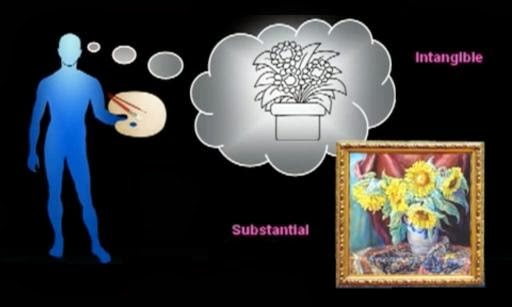
We are all familiar with the process of creation by humans. An artist for example first has an idea in his mind. The idea is invisible and insubstantial, but it has a “reality” to it. No one would deny its existence. Nor would anyone deny that there was no intelligence at the source of the idea. Without the intelligence first, then the idea next, there would never be the artist’s painting. Order and complexity originate from an invisible idea. Randomness and chaos do not become ordered unless acted upon by a force that originated with an invisible intelligence and an idea. In fact, we know that randomness and chaos tend toward greater and greater randomness if left alone (see Second Law of Thermodynamics) [2].

To try to explain order and complexity, not to mention life itself, by purely mechanical or mechanistic causes totally ignoring any invisible intelligence is “Garbage In”. All the observed processes of nature are being violated. “Garbage Out” is to be expected no matter how good your program/explanation is.

Here are some pictures of excavations of ancient ruins. Suppose I decide to believe that it was impossible for human beings to have existed in the place where the ruins were found. I would have to come up with an explanation that excluded intelligence.


Let’s call it the “Theory of the evolution of ancient ruins”. Random storms and winds and earthquakes must be the cause. Maybe we have to add in bacteria and small animals too. These forces have left behind complex rock formations that look designed but certainly could not have been designed because there was no intelligence involved. We can only talk about natural forces and not supernatural ones. Surely we would get deeply caught up in the processes of the storm systems and the flow of water, how winds form patterns on sand dunes, and how earthquakes shear off rock surfaces.

Are you seeing the “Garbage In”?

We combine all the forces together and tell a wonderful story about how it all “must have happened”. We even still recognize the odds are millions and millions to one that it could have happened. But there it is right here in front of our eyes, so we know it happened. Just given enough time and the odds somehow worked out so that it must have happened the way we imagined.

Our story of how it happened took a lot of intelligence to come up with, but there could not have been an intelligent force working to create the ruins. We’re certain of that because we decided it at the beginning. These explanations are the best we can come up with using all our scientific abilities in this age, so they must be correct. We don’t need to resort to some idea of intelligent design or god. Sure there are some gaps, but they will be worked out by future scientists. Besides that, we are all in agreement, minus a few religious fanatics and ignorant peoples.

Garbage out.

Any rational person looking at those pictures of ancient ruins, as simple as the design and order are, immediately concludes that there was an intelligent source. The more complex and complicated are the ruins, then the greater intelligence is assumed for the creators. The complexity of a single cell is orders of magnitude more complicated than these ancient ruins and yet some people insist a cell could come about by random mutation. Garbage out. Intelligence is invisible, but it is still real.

There must be a God.
----------------------


Thursday, February 13, 2014

#51 Pollination

We are all familiar with pollen, but I think most of us don’t know much about the pollination process, nor have we thought about it deeply in the context of Evolution vs. Creation. I sure didn’t until recently.


In reading a number of articles I quickly discovered that the process is extremely complicated. One amazing thing that I did not know is that in the vast majority of plants pollination is required BEFORE a seed is able to be produced. No pollination, no seeds.

Only about 10% of plants are pollinated by wind or water. The other 90% require some animal or insect to be involved to transport the pollen.[1] This is very complicated and difficult to imagine how any evolutionary process over time and small changes could possibly work. We are supposed to believe that wonderful harmony and mutual benefit came about accidentally. Humans have a really hard time producing it on purpose. It’s even harder to imagine when you learn that some plants do not have random pollinators, but have specialized to the point that only one particular insect is allowed to do the pollination.


Pollen has been around for millions of years. It is known to have remained virtually the same for 120 million years. No changes. How could evolution stop completely for that long (if it was ever working at all)?

Every individual type of plant has its own uniquely shaped pollen. That is amazing in and of itself. No repeats. Pollen is so unique and unchanging that it can be used in a court of law to determine exactly where an item has been if it contains a certain pollen.


You may have heard about the famous Shroud of Turin, touted as the burial cloth of Jesus. Interestingly, scientists know by the pollen in the fibers some of the exact areas in the Middle East where it must have traveled at one time. [2] [3]

Through many amazing adventures, pollen eventually arrives at its destination, then many phenomenal fertilization processes begin taking place. The pollen contains the male gamete (like sperm) that must fertilize the female part of the plant. In many cases it is very difficult to get to the female gamete and the pollen will actually grow a long pollen tube that deposits the male nuclei into the egg.


Actually there are usually 2 male nuclei in the pollen. One will fertilize the egg and the other will unite in a different way and produce the section of the seed that contains the nutrients for the later growth of the seedling plant.


Every one of the complex stages of pollination shows God’s intelligent design. If you try to imagine how a totally random process that works slowly over many generations and small incremental changes could produce such magnificence, forget it. The gaps are too impossible. The probability is too great that even one plant species could do it, let alone the hundreds of thousands of plants all being able to accidentally do it. Add to that the fact that many of the plants do it in different ways so somehow each would have had to “evolve” separately.


Here’s a good question of those of the Evolution faith. Did pollen come first or did the plant come first? If pollen somehow came first, since this is the male part, how could the female part have accidentally evolved at the same time and in the same location so there could be fertilization?


Fertilization is really, really complicated. Check out this “Plant Fertilization” tutorial [4] for a fairly simple to understand explanation.

If they somehow met up, how could they have the exact matching DNA? What are the odds? How many times would that process happen before the right sequence of changes takes place so a seed will result with its own nutrients included within the seed shell?

Even if you had a seed, how did the instructions get in the seed to produce a plant that would grow up and produce more of the exact pollen you started with? Even if you had one plant, you would still need another plant with the same DNA nearby for cross-fertilization.

Cross-fertilization is very important to understand. [5] It means that a plant cannot fertilize itself with its own pollen. This probably helps with plant immunity, but how could that be attributed to “survival of the fittest” when it’s so much harder than self-fertilization. The vast majority of plants require cross-fertilization and there are incredibly fascinating mechanisms that different plants have to prevent self-fertilization and facilitate cross-fertilization. Some plants hide away their female parts until all their pollen has been removed. Some plants have the male and female areas in separated places. Some plants only allow a certain type of insect, for example, to get to their pollen and transfer it. In some cases, scientists don’t know how a plant’s own pollen is recognized and rejected.

Speaking of insects and other pollinators, just read up on some of the intricate processes that plants have to attract insects or animals to come near. Do plants have brains that thought up the idea of manufacturing sweet nectar to attract a bug? How did that happen? That nectar is providing food for the insect but no benefit to the plant itself. The plant is amazingly generous to give away all that good stuff and not use it for itself somehow. How could a plant have been pollinated before the development of the sweet nectar? How could the nectar evolve over many generations to just the correct sweetness formulation? If only one plant had nectar, why would the insect go to the next plant carrying the pollen? The pollen won’t fertilize just any plant, it has to be exactly the same species and a DNA match.

It seems inconceivable that any evolutionary process could start with only pollen. But it’s also just as inconceivable that if you start with a plant and follow the principles of evolution that you could ever develop a system like pollination in a slow and gradual way over many successive generations.

Scientists don't know where plants came from.

“The ancestors of flowering plants currently remain a mystery, and scientists aren't sure what kind of events or conditions might have spurred their origin.

"’So far, no direct ancestors of flowering plants are known," Hochuli said. "Some groups of plants are suspected to be closely related. But the evidence is weak, and most of these groups are thought to be too specialized to be at the base of the flowering plants.’" [6]

In this scenario, you would have to start with a plant that could fertilize itself somehow. But starting there, how did it suddenly develop pollen grains that have two male nuclei? Even then, what good is male pollen unless there was also the female ovule accidentally developed at the same time on the same plant. Even if you had that, how would you eventually get to two separate plants that both require cross-fertilization? The odds of two plants appearing spontaneously and being a matched DNA pair is astronomical. If randomly a plant grew that required cross-fertilization from another plant, how could it ever become dominant?[7]  

Plants make so many kinds of seeds, nuts, and fruits. Could it have just accidentally happened that most of these are good for birds, animals, and even humans to eat? No way.


Could it be accidental that these foods are mostly nutritious and not totally worthless or even poison? No way. Could it be accidental that they all taste so good? No way. It’s beyond obvious that it was designed.

There clearly is God.         
----------------------------------------


[3] The Shroud of Turin - Evidence it is authentic, http://www.newgeology.us/presentation24.html


[6] Ancient Roots: Flowers May Have Existed When First Dinosaur Was Born, http://www.livescience.com/40088-flowers-existed-with-dinosaurs.html


Wednesday, February 5, 2014

#50 Scientists Are Wrong A Lot Of The Time

If you think back over the history of science, you will recognize that many, many times the scientists have been wrong. One might even be able to make the case that they are usually wrong.

Do they think they are wrong at the time? No. They think they are right with almost absolute certainty, just like today. The scientists who thought the earth was the center of the universe not only believed they were right, they violently opposed Galileo when he said the Earth revolved around the Sun. Why did they do that?


To have some fun and surprises you might check out some of the websites about major mistakes that scientists have made in the past: Top 10 Science Mistakes [1], Top 10 Disproven Theories [2], Why Most Published Research Findings Are False [3], Most Scientific Theories Are Wrong. [4]

For some more fun, check out on these websites for some of the more famous quotes by science and world leaders who were wrong: It’ll Never Work [5], Incorrect Predictions [6], Predictions-Quotes.[7]

Try naming any scientific breakthrough that was not strongly opposed. In fact, I would make the case that the strongest opposition usually comes shortly before the new idea gains wide acceptance because that is when the opponents fight the hardest to stop it. Check out the history of the locomotive, electricity, automobiles, airplanes, television, radio, and computers to name a few.

Do you think that scientists all jumped on board with Einstein and instantly accepted the theory of relativity? Maybe there was no heated debate and angry words. Wrong. That’s not how it works.

Einstein himself admitted that he had made a big mistake after refusing for years to accept that the universe is expanding. He even went so far as to fudge his formula to avoid the new truth and account for data outside his pet theory. In the end he called this his “greatest mistake”.[8]

Have you heard that the sum total of knowledge in the world is doubling every 12 months (and on its way to every 12 hours)? [9] Incredible. Obviously we don’t know it all, do we? Ask any honest scientist and he/she will admit that there are a lot of things they don’t know in their chosen field…maybe even more than they think they already know.


We tend to think that we know it all today, the full and complete truth. Only those people in the past were ignorant, but not us. Not even close.

We tend to think that truth is always accumulating in a straight line and always going upward, new truth gets added on top of old truth and they always agree with each other. Nope. New truth will often turn out to be significantly opposed to the old truth. New truth will contradict the old “truth” because the two are incompatible.

One of the “most influential philosophers in science of the 20th century” is probably someone you never heard of. His name is Thomas S. Kuhn [10] and in 1962 he wrote a book called The Structure of Scientific Revolutions. He is the one who popularized the term “paradigm shift”.


“According to Kuhn the development of a science is not uniform but has alternating ‘normal’ and ‘revolutionary’ (or ‘extraordinary’) phases. The revolutionary phases are not merely periods of accelerated progress, but differ qualitatively from normal science.”

…anomalies are ignored or explained away if at all possible. It is only the accumulation of particularly troublesome anomalies that poses a serious problem for the existing disciplinary matrix. A particularly troublesome anomaly is one that undermines the practice of normal science. [11]

He explained historically how science only progresses in a straight line for periods of time and then a revolution takes place when there is growing uneasiness with the “truth” because it doesn’t explain the new data.

This is exactly what is happening to the Theory of Evolution. The theory is not able to explain the data very well any more.


“Like all other scientific theories, Darwinian evolution must be continually compared with the evidence. If it does not fit the evidence, it must be reevaluated or abandoned--otherwise it is not science, but myth.”

“If the icons of evolution are supposed to be our best evidence for Darwin's theory, and all of them are false or misleading, what does that tell us about the theory? Is it science, or myth?”[12]

99.9% of all known fossils have been discovered since the time of Darwin, but his “missing links” have never been found. [13] The same goes for the two forces of mutation [14] and natural selection.[15] They are failures at experimentally producing any new species. Now we see the Theory of Intelligent Design emerging in opposition. We also see it is being almost violently opposed. Adherents of Evolution want Intelligent Design people to shut up and are trying to get their jobs taken away.[16] They vilify esteemed atheists who change their minds. [17]

I predict Intelligent Design will win the battle because it better explains the data.

If you look on the horizon, you can see other revolutions in thinking and “truth” that are coming. For example, look at all the books being writing by very distinguished and credible people who have lived through and returned from a “near death experience”.[18] Many others are now coming forward to testify to their own experiences of life after death. It is showing up more and more on television and in movies. Eventually it will be undeniable.

Another example is in the fields of psychology and medicine. Research is making amazing advances in alternative methods of healing that are more successful. Most people are unaware of what is happening below the surface and out of the public media. Individuals like Mahendra Trivedi are popping up around the world. Over 4,000 scientific experiments have verified his energy healing abilities. [19]


Once it is established that there is life after death, a huge paradigm shift will take place in the world and how people live their lives. Perhaps it will be gradual but the world will change tremendously as people adjust to the idea that they will live forever and the way they act in this life will determine what happens to them in the next.

These developments and discoveries are not random. There is an invisible, intelligent force at work behind the scenes working with the people who are making these discoveries. That being is the origin of this knowledge and is helping it be revealed to the world.

There is God and He/She will eventually be known by all of us, even a reluctant scientist.
_________________________


[3] Why Most Published Research Findings Are False. http://www.plosmedicine.org/article/info%3Adoi%2F10.1371%2Fjournal.pmed.0020124


[8] Einstein’s Mistakes: The Human Failings of Genius by Hans C. Ohanian explains 23 mistakes that Einstein made including the one in 1917. http://discovermagazine.com/2008/sep/01-einsteins-23-biggest-mistakes#.UvGzZfldXy0

[9] David Russell Schilling article, "Knowledge Doubling Every 12 Months, Soon to be Every 12 Hours", April 19th, 2013, http://www.industrytap.com/knowledge-doubling-every-12-months-soon-to-be-every-12-hours/3950

[10] Wikipedia, Thomas S. Kuhn, http://en.wikipedia.org/wiki/Thomas_Kuhn

[11] Thomas Kuhn information. http://plato.stanford.edu/entries/thomas-kuhn/

[12] Jonathan Wells, evolutionary biologist and author, Icons of Evolution, website: http://www.iconsofevolution.org/intro/


[14] Proof for God #27, The Truth About Mutation, http://101proofsforgod.blogspot.com/2013/02/27-truth-about-mutation.html


[16] Ben Stein, movie: Expelled: No Intelligence Allowed, http://topdocumentaryfilms.com/expelled-no-intelligence-allowed/  Be sure to Google it so you can see how it is vilified.


[19] The Trivedi Foundation website: http://www.trivedifoundation.org/